 Benjamin announces to no one in particular that someone on Twitter is predicting the FMLN to win. "51 to 49 percent" he summarizes. Francis stubs out his cigarette, looks at his watch and pushes past me on his way to the computer. As much as this means for me, I know it means more for them.
As mentioned in my previous article, "Not Just Some Fractured Fairy Tale," my roots with Salvadorans go deep and in each face, and in the faces imagined, one can see a range of emotions. Ben and Francis are two Americans by birth. Their families, for whatever reason, fled Salvador during the civil war in the 1980s and tonight, those memories will be closing for some.
"You spent six BILLION dollars," Francis emphasizes outside, the "you" taken someone hurtfully, "to try to stop the FMLN and here they are."
"Will they win," I asked.
"Who knows? Did they win last time?"
Francis has been a friend of mine since high school who came down for the weekend. We went to a classmate Ben Orantes' apartment outside campus, also of Salvadoran origin. Ben has never been back to his homeland, Francis only once - briefly. Ben grew up in San Antonio, Texas with his mother until he decided to get back with his father who found his way into the US Navy (and then, like many, to Norfolk). Francis never saw his father, who worked in North Carolina and lived with his mother in Manasssas, VA. Their parents both left to avoid the violence during the civil war, along with roughly a million other refugees absorbed by the US.
"No," Ben said earlier in the night. "My parents live here now, they have no roots. He was not a guerrilla," referring to the soldiers in opposition to the US-backed government, "he was too young. I don't think they will go back."
Salvador has been trying to curb emigration from its country and some believe that the election of the FMLN and Mauricio Funes will actually bring Salvadorans back from the US, especially with the global recession in full swing.
"If Funes [the candidate running for the FMLN, the left wing party] wins," Ben continues, "I don't know if people will go back, it's been hell, you know, for the past twenty years."
In 1992, El Salvador signed a peace accords with the FMLN guerrillas. The accords stated that the political process would be open to all and, for the most part, this was true. Elections were held in 1994, 1999, 2004, and yesterday. Each election saw the right-wing ARENA party, founded by death squad leader Roberto D'Aubuisson (Rodrigo Avila, who ran for president for ARENA this cycle has admitted to killing guerrillas during the civil war) victorious, mostly because it had the backing of the US government, which in 2004 threatened the Salvadoran people into voting ARENA with threats of ending remittances, which make up 20 percent of its economy. This election is seen as a referendum on ARENA and coincides with a general shift left-ward in Latin America. The major issues facing Salvador continue to be corruption, violence, gangs, and remittances. Each promised to deliver, but only time will tell.
The TES, the election counting board, representative comes out twice until around 8:30 Salvadoran time (10:30 EST) when he congratulates the Salvadoran people for a peaceful, free election and announces Mauricio Funes as president elect of El Salvador.

"Fireworks are going off in Sonsonate!" Ben announces, pointing to the Twitter screen. Francis is elated. As am I. There are a lot of unanswered questions but they have no place for tonight, which is the night of celebration.
"I have class tomorrow," I tell the two as they begin to pull out some beers from their refrigerator.
"What class?"
"Spanish, at 9:00."
"Olvídese de clase de español, a aprender español en el mundo real y esto, amigo mío, es el mundo que hemos estado esperando durante años!"
I needed to forget class. One learns Spanish not in a classroom but in the world. And tonight, the world belongs to El Salvador - they've waited years for it.
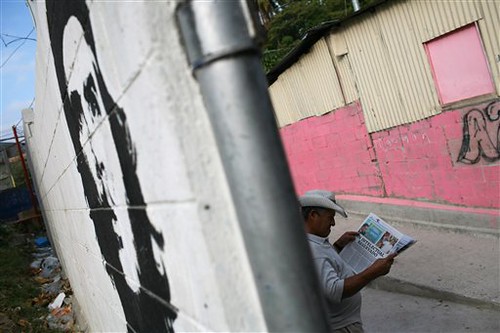
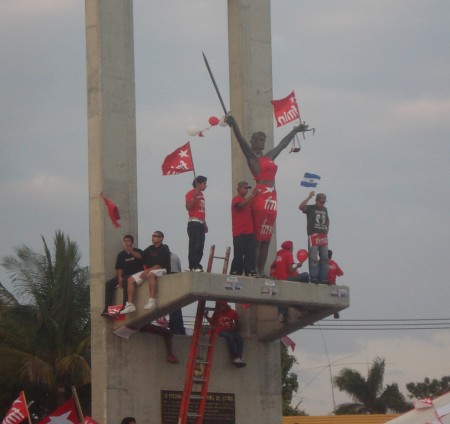
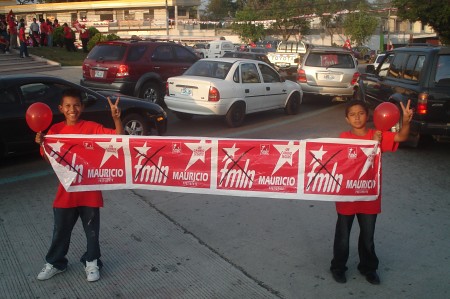
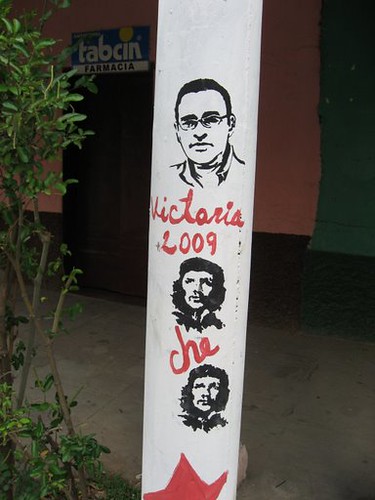
Photos from El Salvador on Election Day